


Christopher Cozad's Turbo D dreadnaught guitar is the first acoustic guitar designed to take advantage of the TurboTail and a Free Soundboard. This allows string tension to transfer from the bridge and delicate soundboard to the structural tailblock.
Can an Acoustic Guitar Function Without Soundboard Bracing?
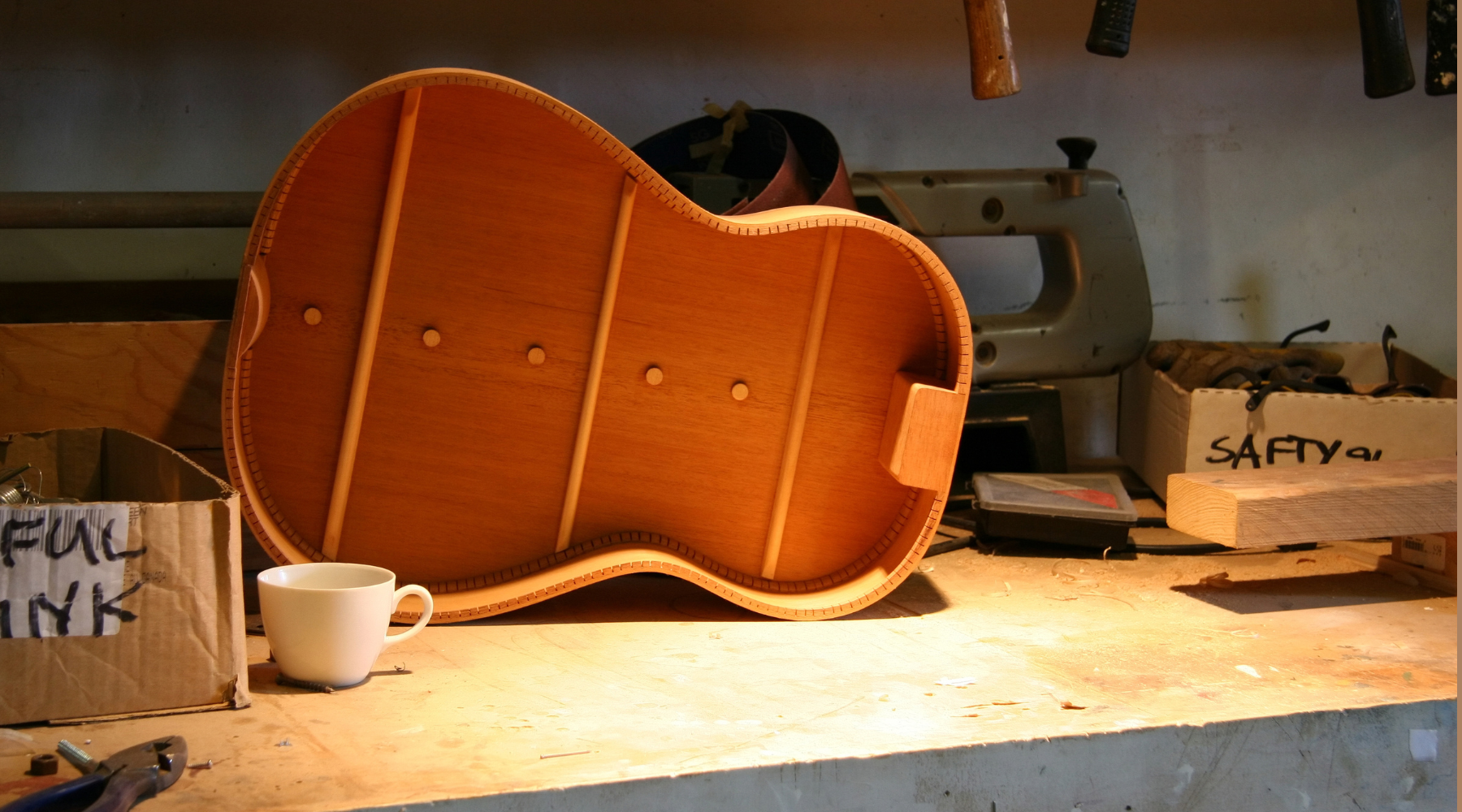
For years, Cozad wondered what voice a wood acoustic soundboard might have if it didn't need bracing merely to prevent it from deforming or buckling.
Christopher’s experiments with reducing soundboard bracing led him to conclude that his guitars sounded bigger, deeper, and more dynamic, the less bracing he applied….. right up until they failed structurally. To put it bluntly, his very best sounding guitars self-destructed, sometimes over a few months or weeks, one time overnight after tensioning the strings.
Exploring the TurboTail

Christopher conducted a number of experiments and explorations with the TurboTail before he decided to build a guitar using the TurboTail.
We invite you to read Mr. Cozad’s article, The TurboTail,
According to Christopher, there are three main issues which plague all conventionally built acoustic guitars: 1) Forward Neck Bow, 2) Body Flexion / Neck Block Shift, and 3) Bridge Rotation.
What Causes Bridge Rotation and Belly Bulge in Acoustic Guitars?
He found that the TurboTail solves the 3rd issue: Bridge Rotation, and by solving that issue, it also prevents soundboard deformation.
Bridge rotation initiates soundboard deformation which is caused by the pull of the strings on the bridge which forces it to rotate forward, forcing the soundboard to deform into an “S” shape curve. That is, it causes a depression in front of the bridge and a bulge, affectionately called a "belly", behind it.
The degree of deformation a soundboard will experience is directly proportional to how it was constructed and the string tension it will be subjected to and how long that tension is applied. Environmental conditions, such as heat and humidity, also impact deformation.
Is Soundboard Deformation Inevitable?
There is a longstanding belief among guitar builders that soundboard deformation is a “normal”, eventuality. Builders use various techniques to minimize it, such as increasing the stiffness of the soundboard, minimizing string tension by using shorter scale lengths, lighter gauge strings, etc. This argument suggests that the key for builders is to accept this inevitability, try to moderate using the various techniques, and have a strategy to compensate for this distortion after it occurs (e.g., adjustable neck joints).

So many books and articles have been written on this subject that this belief has become embedded in guitar builder culture, almost like religious scripture.
But is it true?
The Turbo D: A Free Soundboard Dreadnought Guitar
Experiments with the TurboTail have convinced Christopher that when the bridge is supported by the TurboTail, he can re-focus his attention on generating sound.
Christopher chose the iconic dreadnought body shape for his first “Turbo Guitar”.
Basic features of the Turbo D include:
-
Rosewood back and sides,
-
Torrefied Sitka Spruce soundboard,
-
Bolt-on neck with 14-frets to the body neck joint
-
25.5-inch scale length
-
Transitional arm bevel
-
Soundport
-
TurboTail
Inside the body of the guitar:

-
Laminated linings which are stronger than kerfing
-
Carbon fiber rods from neck block to just behind the waist to prevent neck block rotation.
-
Carbon fiber rods from the center of each waist block to each side of the tail block at the precise point where the TurboTail is mounted. This provides a secure point of compression resistance to the wire tensioners ensuring that the soundboard remains stress free. It also connects the carbon fiber rods to the body in a stiff diamond shape.
-
Ultra light radial bracing - without the TurboTail, such a lightly-braced soundboard would not have supported steel string tenision….. at least, not for very long

Traditional Belief in Structural Soundboards
Christopher contends that, when building today's steel string acoustics, builders and manufacturers have settled for a compromise between designing for structural soundboard support and generating the fullest, most pleasing tone. This is all due to the traditional belief that the soundboard must provide necessary and essential structural support.
Soundboards With No Structural Support?
However, when designing with the TurboTail, the soundboard no longer requires structural undergirding as it does in a conventional, X braced guitar. By stabilizing the body of the guitar against flexion, yet excluding the soundboard from this process, Christopher has created a sturdy, road-worthy instrument with an incredibly responsive soundboard.
Kinlock Nelson Plays the Turbo D
The big question is: how does the Turbo D sound?
We are happy that fingerstyle guitarist/composer Kinloch Nelson took the time to play the Turbo D.
In this video, Kinloch is playing Great Dreams From Heaven on the Cozad’s Turbo D.
Please let us know how it sounds to you.
A 100% Braceless Soundboard Guitar - Another Cozad Guitar
At the time of this writing, Christopher is already well into building his second Free Soundboard Guitar. This time he is using the TurboTail to eliminate 100% of soundboard bracing.
Christopher will be using a magnetic caliper to do a methodical thinning of the soundboard after the guitar has been assembled. By using this method, he hopes to be able to fine tune specific areas of the soundboard to optimize projection, sustain, and tone.
Christopher encourages other builders to try the TurboTail and the Free Soundboard approach to guitar building. He plans on building all his future guitars with the TurboTail.
For more about Christopher Cozad and his guitar building adventures, visit CozadGuitars.com.
We’d love to hear from you when you build your first Free Soundboard/Turbo Guitar.
Thanks for reading.


Share:
Steel Strings on a Classical Guitar?
Kinloch Nelson, Takamine 132S, Steel Strings, and the TurboTail